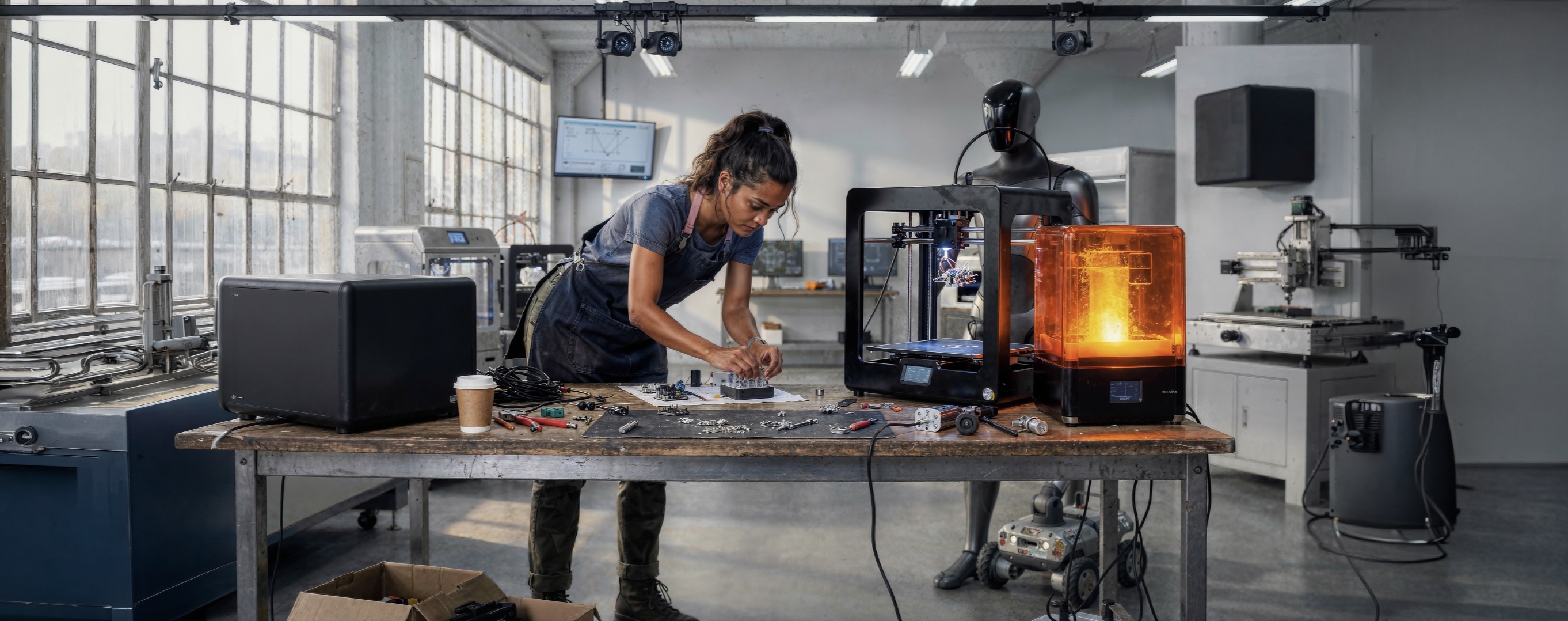
Picture a garage. Not the mythologized Silicon Valley kind. A real garage. Concrete floor. LED lights in the ceiling that adapt continuously to the sunlight and weather outside, keeping the space in a constant, natural balance.
It's early 2027. Someone walks in. She sets down her coffee. She doesn't work for anyone. She doesn't have a team. She has something different.
What if we imagine how this space actually looks?
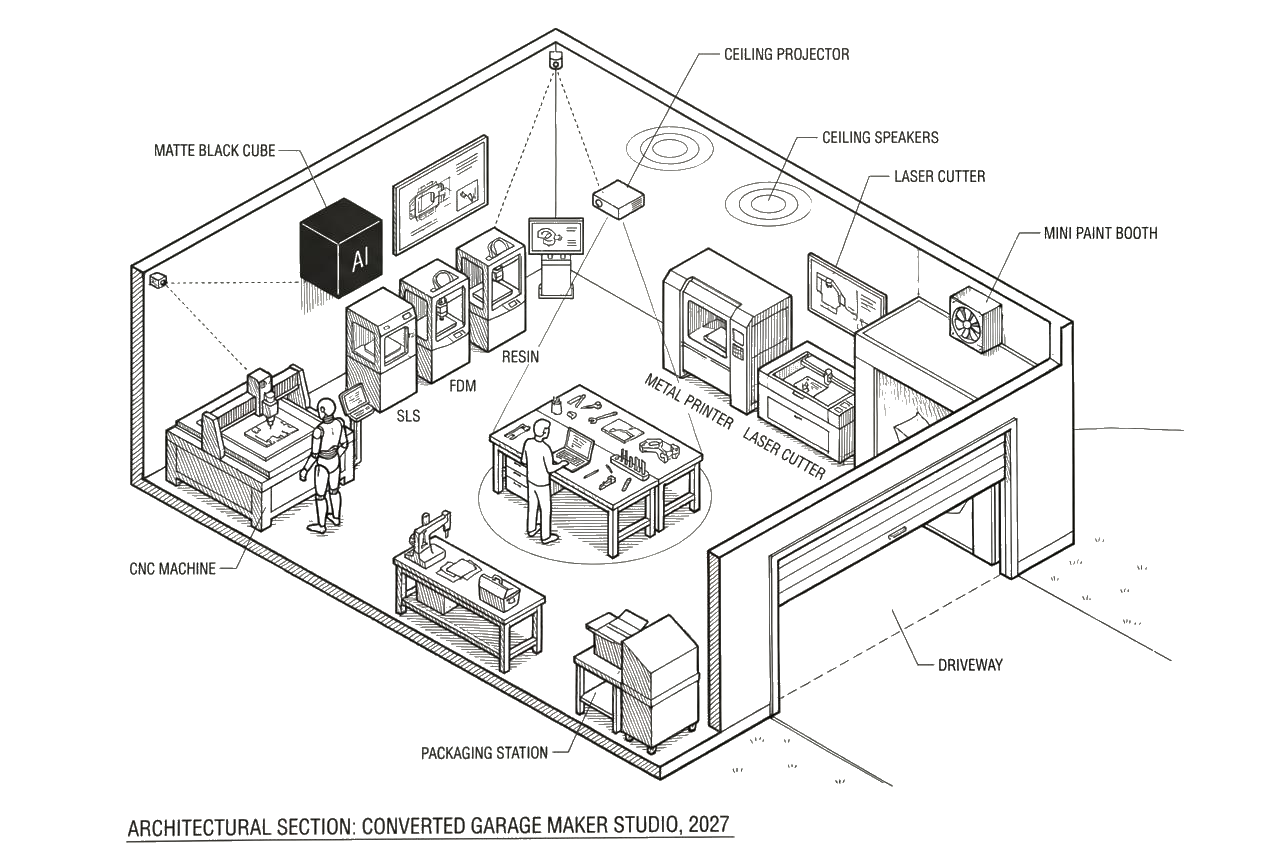
On her left, a humanoid robot stands in rest position. Matte gray, roughly human sized, functional. She refers to him as he. He's her assistant. He moves things, holds things, monitors things. When she needs a part held at a precise angle while resin cures, he holds it. When she needs components sorted, he sorts them. He watches the 3D printers and the CNC machine, catching errors before they cascade, stepping into the CAD software to troubleshoot when a file isn't behaving. The CAD package itself is agentic, self correcting, so the robot and the software work together, a collaboration between a physical AI and a software only agent. Sometimes he offers suggestions on assembly. He's not decoration. He works.
Behind her, three 3D printers hum. SLS for precision nylon parts, layer by microscopic layer. FDM for fast structural prototypes she can test in her hands within the hour. Resin for detail work with a surface finish that looks injection molded. In the corner, a laser cutter, a metal printer, a mini paint booth, an AI powered CNC machine. Near the garage door, a small packaging station prepping ecological packaging, ready to ship.
On the opposite wall, a black cube. Maybe 50 centimeters on each side. No screen. No blinking lights. Matte black, mounted cleanly, single power cable to the wall. Quiet. Almost monastic.
That cube is not just her second brain. It's her third and fourth brain. It's the cognitive partner running her entire operation. It generates code. It runs structural analysis. It creates content for her social channels. It manages her supply chain. It builds financial models. It handles scheduling, customer communication, market research. It is the engine behind every workflow and the quiet intelligence at the center of her practice.
The garage has vision. Small cameras positioned in every spot where she needs eyes. Omnidirectional microphones and speakers mounted in the ceiling, always on, always listening. She never has to stop what she's doing to interact with her systems. She just talks. Naturally. Like a person in a room. From deep technical discussions about her development pipeline, to content strategy, to joking around while she waits for a print to finish.
Screens are placed throughout the space, each one serving a different purpose. One tracks the 3D production pipeline. Another follows her AI agents as they move through tasks. A projector mounted in the ceiling throws interactive layouts and schematics onto a large worktable. Each screen is a window into a different thread of her work, all running in parallel.
And here is what might be easy to miss if you're just reading about the technology. She builds software. That's her primary work. But she also fabricates physical products, prototypes, custom hardware, whatever she's interested in that particular week or month. Because the time between having an idea and holding it in her hands has collapsed to almost nothing, she can switch gears with a fluidity that would have been unimaginable five years ago. Her workflows overlap. They don't follow steps. They flow. Like water.
When she gets stuck, and she does get stuck, her AI doesn't just wait for instructions. It coaches her. It helps her think through a delivery conflict. It helps her prioritize when two deadlines collide. It offers perspectives she might not have considered. And then she decides. She always decides.
This is not a concept rendering. Every piece of this setup exists today. The humanoid robots are shipping from multiple manufacturers. The 3D printers have been consumer grade for years. The AI models are more capable than most people realize. The only thing that hasn't happened yet is assembly. Someone putting all these pieces in one room, for one person, with one vision.
That will happen. Soon.
I've spent years inside this work. Thousands of experiments. But being inside something also means being willing to look at it honestly, critically, and with care for what changes alongside the opportunities.
Because the garage is not the whole story.
What if we imagine how this plays forward?
For fifty years, making things was the hard part. Execution was expensive, slow, dependent on teams and capital and supply chains. So we built processes to manage that expense. Design methodologies. Sprint cycles. Phased development. All necessary, because you couldn't afford to build the wrong thing.
We used to have an acoustic piano. Beautiful, but limited to its physical strings. And then someone built a synthesizer that could create any sound ever imagined. The keyboard looks similar. Your hands still play it. But the range of what's possible exploded beyond recognition.
The garage is the synthesizer. The tools inside it can embody any shape, adapt to anything. They bring a kind of creative explosion that is nonlinear, fast, and deeply unfamiliar to anyone trained in the old sequential methods.
But you still need to know the notes. You still need to know what kind of composition you want to make, and why.
This is what exponential looks like when it lands in a physical space. Exponential capability. Exponential creativity. Exponential customization. Exponential speed from intent to reality.
And it's available to anyone.
It empowers anyone, of any background, any neurotype, any starting point, to develop what they want to build. You can start at phase four and work backward. Go one, three, two, four. Skip phases altogether and run everything in parallel. The rigid sequence is gone. What remains is you and your intent, amplified by systems that adapt to how you think.
Direct access to knowledge. Instant learning. The ability to dip into any expertise the moment you need it. The walls between disciplines aren't broken. They're dissolved. They were sugar walls all along. We just couldn't see it until the water arrived.
Now imagine a city. A million people. And imagine all of them have access to a setup like this. A million people, each able to create a million things, each day.
Sit with that for a moment.
What are they building? Who are they selling to? What happens when everyone is a maker? When every garage is a factory and a studio and a software company? What are they scaling?
The creative output would be extraordinary. Ideas that used to die in notebooks because someone lacked the resources, those ideas now live. They become physical things. Software that works. Solutions to problems that only someone living that specific life would even notice.
That is the promise, and it is real, and it is beautiful.
But there's a gentle paradox inside the abundance. If everyone is creating, who is the audience? What makes one person's work matter more than the next?
And how are we supporting each other? Our communities? The people around us? Because we are part of everything and everything is part of us. The tools are powerful, but the questions underneath them are ancient. What do I care about? Who am I helping? What kind of world am I contributing to?
A lot of people are going to be affected by this shift. Not just entrepreneurs and makers. People who have spent years, decades, building careers inside structures that may not exist in the same form soon. Roles that existed because execution was complex and coordination was expensive.
The project manager who built a career on coordinating what machines now coordinate themselves. The junior designer whose first years were spent on production tasks that an AI finishes in minutes. The supply chain analyst whose models are now generated before the morning coffee is cold.
Every one of those roles is a person. With a life, a family, a sense of identity woven into their work. I see most changes as opportunities for transformation into something better. That is the principle I've lived by. But I also know that transformation is not painless, and pretending otherwise would be dishonest.
What I've seen, consistently, in my own practice, is that the qualities that matter most in this transition are not technical ones. They're the ability to see what others don't see. The willingness to care about a specific problem for a specific group of people. Empathy. Attention. The patience to sit with an idea before rushing to make it real.
These are human qualities. And they are precisely the ones the machines cannot replicate.
She wakes up.
She doesn't go straight to the workbench. She sits. She meditates. Not as a ritual for its own sake, but because she's learned that the mind is like a jar of river water. Constantly shaken by notifications, news, the anxiety of what's next. Cloudy. She sits still and lets the mud settle. Until the water becomes clear. Until she can see what actually matters today.
The robot is already on, doing his morning tasks. The printers are warm. The black cube is awake.
She walks in. The AI greets her. A brief conversation. What are we tackling today? What's the priority? Almost like a colleague who arrived earlier and already has the coffee going.
And the most important part of her day is this moment. Not when the machines start producing. This moment. The still point before the motion. The clarity that comes from sending the mind inward instead of outward.
The printers will print anything. The AI will generate anything. The robot will assemble anything. They are beautifully, powerfully indifferent to meaning.
I want to be clear about something. This is one possible picture. There are many ways the future can be imagined. I went here from the perspective of the scrappy, self directed maker who very soon will be able to do enormous things from a small space. Others will imagine different pictures, and those pictures will also be true.
But I find these thought experiments genuinely helpful. In a time when the news moves fast and it's easy to slide into anxiety, it helps to slow down and actually visualize what these changes look like when they become physical. When they become a room you can walk into. A workbench. A cup of coffee. A morning conversation with an intelligence that knows your work as well as you do.
Because reading about the future is one thing. Seeing it is something else entirely. And images carry a thousand words.
The everything garage is almost here. The machines, the intelligence, the capability, all of it converging into a space that fits in a two car garage.